About Types Of Dental Sharpening Stones
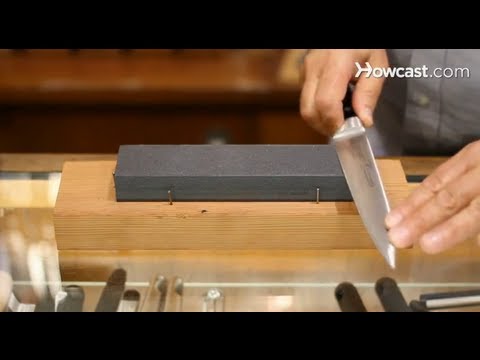
Abrasive piece utilized to sharpen tools Sharpening stones, water stones or whetstones are utilized to sharpen the edges of steel tools and executes through grinding and refining. Examples of items that can be honed with a sharpening stone consist of scissors, scythes, knives, razors, and tools such as chisels, hand scrapers, and plane blades.
Stones might be flat, for working flat edges, or formed for more complex edges, such as those associated with some wood sculpting or woodturning tools. They may be made up of natural quarried material, or from man-made product. Stones are typically available in numerous grades, which refer to the grit size of the abrasive particles in the stone.
A higher number denotes a greater density and for that reason smaller particles, which causes a finer finish of the surface area of the polished things (3 different types of sharpening stones). Though "whetstone" is often mistaken as a reference to the water often utilized to oil such stones, the term is based upon the word "whet", which indicates to sharpen a blade, not on the word "damp".
The term to whet is so uncommon in this sense that it is no longer mentioned in for example the Oxford Living Dictionaries. One of the most common incorrect idioms in English involves the expression "to whet your hunger", frequently incorrectly composed as "to damp". But to "whet" quite appropriately means "to sharpen" one's appetite, not to splash it with water.
How Different Types Of Sharpening Stones can Save You Time, Stress, and Money.
He describes using both oil and water stones and provides the areas of numerous ancient sources for these stones. Using natural stone for honing has reduced with kinds of whetstones the prevalent accessibility of top quality, consistent particle size artificial stones. As an outcome, the famous Honyama mines in Kyoto, Japan, have actually been closed since 1967.
For instance, the proportional material of abrasive particles as opposed to base or "binder" products can be managed to make the stone cut quicker or slower, as desired. Natural stones are frequently valued for their natural appeal as stones and their rarity, including worth as collectors' items. Furthermore, each natural stone is various, and there are rare natural stones that contain abrasive particles in grit sizes finer than are presently available in synthetic stones. [citation required] One of the most well-regarded natural whetstones is the yellow-gray "Belgian Coticule", which has actually been legendary for the edge it can offer to blades since Roman times, and has been quarried for centuries from the Ardennes.
These are highly valued for their natural elegance and beauty, and for supplying both a fast-cutting surface for developing a bevel and a finer surface for improving it. This stone is thought about among the finest for honing straight razors. [citation required] The hard stone of Charnwood Forest in northwest Leicestershire, England, has actually been quarried for centuries, and gave whetstones and quern-stones.
Synthetic stones generally are available in the type of a bonded abrasive made up of a ceramic such as silicon carbide (carborundum) or of aluminium oxide (corundum). Bonded abrasives provide a quicker cutting action than natural stones. They are commonly readily available as a double-sided block with a coarse grit on one side and a fine grit on the other allowing one stone to satisfy the basic requirements of sharpening.
Getting The Types Of Dental Sharpening Stones To Work
The Ouachita Mountains in Arkansas are kept in mind as a source for these. Novaculite is also discovered in Syria and Lebanon, previously a part of the Ottoman (Turkish) empire, hence using the older name in America of Turkey stone. When the block is intended for installation on a bench it is called a bench stone.
Being smaller, they are more portable than bench stones but present problem in maintaining a constant angle and pressure when drawing the stone along larger blades. However, they still can form an excellent edge. Frequently, great grained pocket stones are used for honing, especially "in the field". Regardless of being a homophone with damp in most dialects of modern English, whetstones do not need to be lubricated with oil or water, although it is very typical to do so.
The Japanese generally used natural sharpening stones lubed with water (utilizing oil on a waterstone reduces its effectiveness). They have actually been doing this for numerous centuries. The geology of Japan provided a type of stone which consists of fine silicate particles in a clay matrix, rather softer than novaculite. Japanese stones are likewise sedimentary.
There is a 4th kind of stone, the nagura, which is not used directly. Rather, it is used to form a cutting slurry on the shiage-to, which is typically too hard to develop the required slurry. Converting these names to absolute grit size is challenging as the classes are broad and natural stones have no intrinsic "grit number".

Oil Stones, Water Stones, And Diamond Stones for Dummies
The naka-to is most likely 3000– 5000 grit and the shiage-to is likely 7000– 10000 grit. Present synthetic grit values range from very coarse, such as 120 grit, through exceptionally great, such as 30,000 grit (less than half a micrometer abrasive particle size). [citation required] A diamond plate is a steel plate, often installed on a plastic or resin base, coated with diamond grit, an abrasive that will grind metal.
Diamond plates can serve numerous functions including honing steel tools, and for keeping the flatness of man-made waterstones, which can end up being grooved or hollowed in usage. Truing (flattening a stone whose shape has been altered as it uses away) is commonly thought about necessary to the honing process but some hand sharpening methods make use of the peaks of a non-true stone.
Rubbing the diamond plate on a whetstone to real (flatten) the whetstone is a contemporary alternative to more standard truing methods. Diamond plates are available in various plate sizes (from credit card to bench plate size) and grades of grit. A coarser grit is used to get rid of bigger quantities of metal more quickly, such as when forming an edge or bring back a broken edge.
 My superb blog 3494